Venerable Master Hsing Yun
Founder of Fo Guang Shan and a lifelong teacher of Humanistic Buddhism (1927–2023).
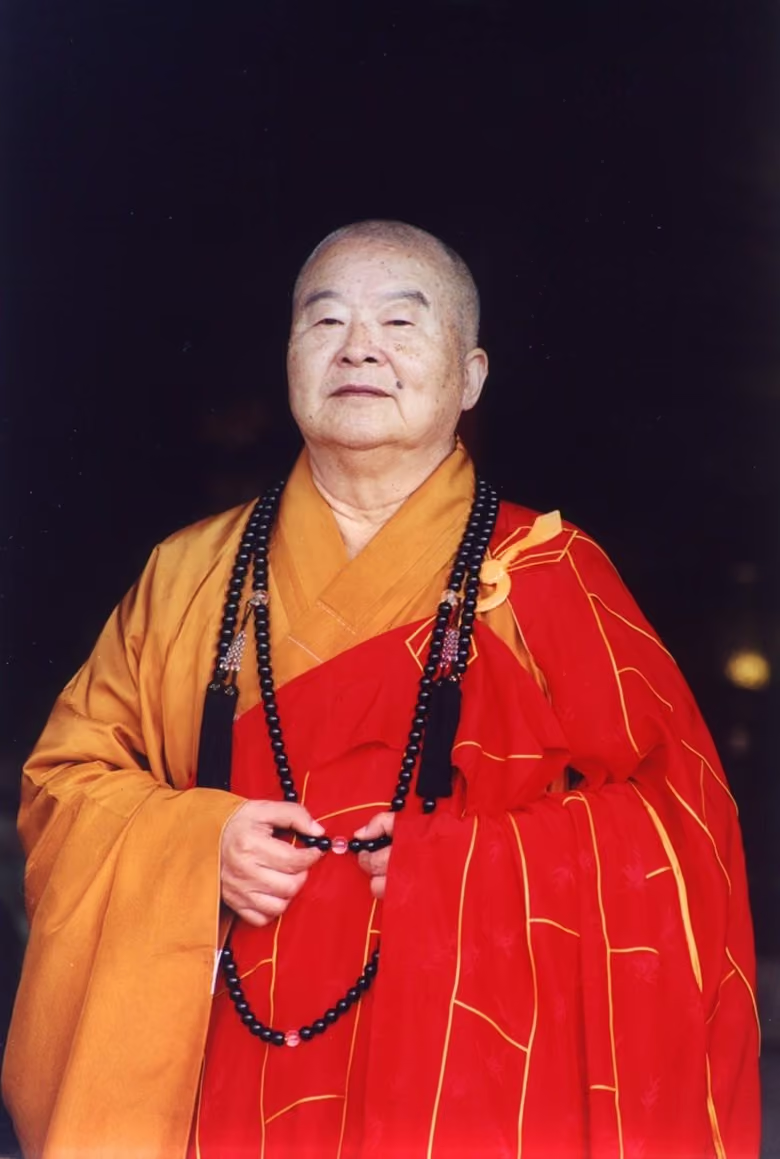
A Teacher to Millions
Venerable Master Hsing Yun was the founder of Fo Guang Shan, the international Buddhist order that Fo Guang Shan Temple of Toronto belongs to.
Over nearly seven decades as a monastic, he became one of the most influential voices in modern Chinese Buddhism — credited with bringing Humanistic Buddhism, the same philosophy this temple was built to teach, to millions of followers across the world.
— Venerable Master Hsing Yun
Early Life
Born in 1927 in Jiangdu, in China’s Jiangsu Province, Hsing Yun grew up in difficult circumstances during a turbulent period in Chinese history. At twelve, he set out with his mother to search for his father, who had gone missing; the journey took them past Qixia Monastery in Nanjing, where he was drawn toward monastic life and became a novice under Venerable Zhi Kai. He received full ordination three years later and was recognized as the 48th-generation lineage holder of the Linji school of Chan Buddhism.
Founding Fo Guang Shan
In 1967, on an undeveloped hillside in the Dashu district of Kaohsiung, Taiwan, he founded Fo Guang Shan around four guiding objectives: spreading the Dharma through culture, cultivating talent through education, benefiting society through charitable work, and purifying the mind through spiritual practice. Those are the same four objectives this temple’s own mission is built around (see Our Mission). Over the following decades, that vision grew into a monastic order with more than 300 temples across six continents — among them Hsi Lai Temple in the United States, Nan Tien Temple in Australia, and Nanhua Temple in South Africa, each the largest Buddhist temple built in its region.
Education & Culture
Education was central to Hsing Yun’s vision for the order. He founded universities on three continents — the University of the West in California, Nanhua University and Fo Guang University in Taiwan, Nan Tien Institute in Australia, and Guang Ming College in the Philippines — alongside sixteen Buddhist colleges and dozens of schools, libraries, and publishing houses. A prolific writer throughout his life, his essays and lectures were eventually gathered into a 395-volume collected works.
Philanthropy
Beginning in 1970, Fo Guang Shan’s charitable arm opened children’s homes, senior citizens’ homes, mobile clinics, and disaster-relief programs across Taiwan and mainland China, extending care to the young, the elderly, and the disadvantaged — the same spirit of service this temple continues locally today (see Spiritual Care).
A Global Buddhist Community
In 1992, Hsing Yun inaugurated the Buddha’s Light International Association (BLIA) in Los Angeles and served as its founding president. What began there grew into the largest Chinese community organization in the world, with chapters in more than 170 countries — including the very BLIA chapter whose founding in Toronto in 1991 led directly to this temple’s own history (see Our History). BLIA was recognized as a United Nations NGO in 2003.
Legacy
Venerable Master Hsing Yun passed away on February 5, 2023, at the age of 97, amid chanting at Fo Guang Shan’s Founders Quarters. He is remembered for reviving the centuries-lost Bhikkhuni full-ordination lineage in 1998, for completing the Fo Guang Buddha Memorial Center in 2011, and for a teaching he returned to throughout his life — the same one at the top of this page. You can read more about his life and work at hsingyun.org.